


News
Kyakabi Data Switches VPS Hosting to KVM

Do you have a Kyakabi Data VPS hosting account, or are you considering upgrading your hosting to VPS? If so, we have some updates for you.
As part of kyakabi’s ongoing efforts to improve our services, we’ve updated our Virtual Private Server (VPS) plans from XEN to KVM virtualization. Kernel-based Virtual Machine, or KVM, is the preferred option for most of the largest VPS providers. We at Kyakabi are proud to be able to offer it to our customers.
Let’s take a look at what this change means to you.
What are VPS and Hypervisor?
When you have a VPS account, your hosting is functionally equivalent to running your own dedicated physical server. However, with a VPS, you have not to worry about any hardware issues on the server, as we will handle them for you. Also with VPS, you will get an easy access to your server through a control panel that allows you to monitor resources or restart your operating system without having to contact support. And if you find yourself running out of space, you can upgrade your plan without having to transfer to a new server.
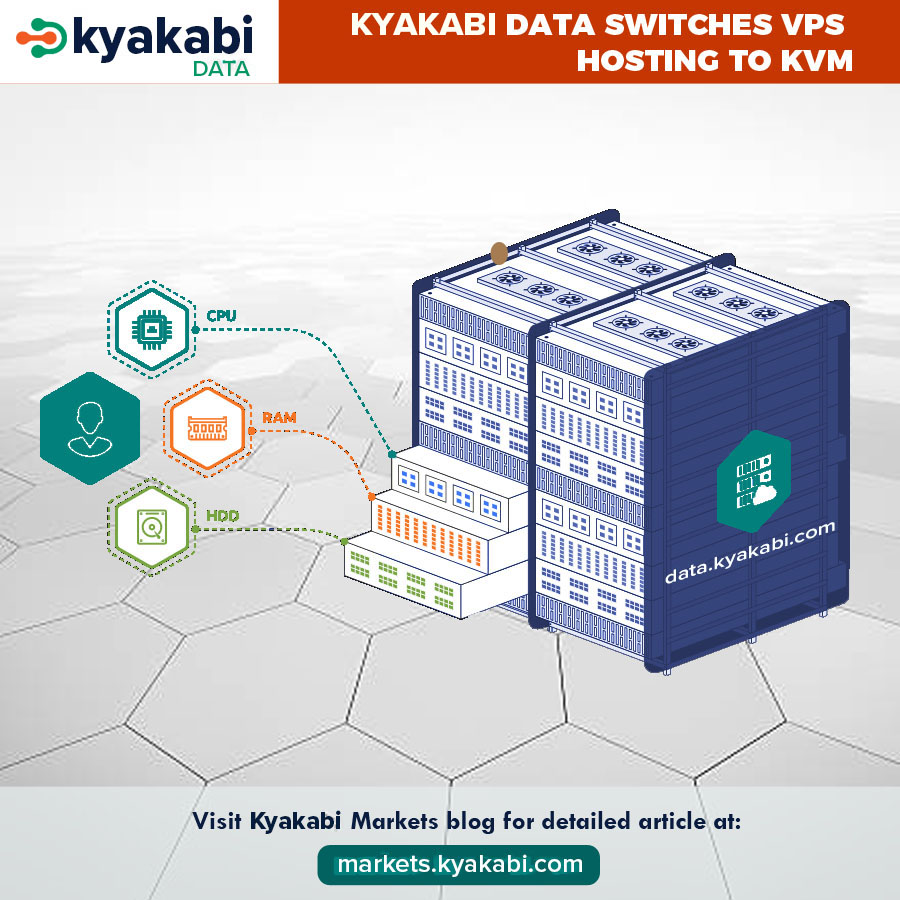 In
order to manage several VPS accounts on
one physical server, we need to install
special software that will allow us to
turn Linux into a hypervisor. This, in
turn, allows our host servers to run
multiple isolated virtual environments
called guests or virtual machines (VMs).
In
order to manage several VPS accounts on
one physical server, we need to install
special software that will allow us to
turn Linux into a hypervisor. This, in
turn, allows our host servers to run
multiple isolated virtual environments
called guests or virtual machines (VMs).
Why choose KVM over XEN?
Here are the main benefits the change to KVM brings to our customers:
- Increased data access – KVM accesses CPU RAM as fast as XEN and is significantly superior when doing IO operations. We report nearly 130% disk subsystem speed increases for our virtual machines.
- Faster virtual machine boot times – This is handy when you need to perform server maintenance with a reboot.
- Faster websites – This is particularly important for media-heavy sites (lots of images and video) or for sites that require database calls (common in WordPress and other sites using MySQL).
- Less CPU RAM usage – With less RAM in use, server processes that need to work with files will finish faster. Think of it like having fewer tabs open in your browser at the same time.
- KVM support currently included in most Linux kernels – Unlike XEN, KVM is not a separate kernel, and this offers an inherently better design. It is also actively supported by Red Hat, allowing our teams to get security patches in a timely manner. We can more quickly mitigate against discovered vulnerabilities such as Meltdown and Spectre so they cannot be exploited.
With KVM, we at Kyakabi Data believe that we can guarantee better overall performance to our customers, as well as stability and greater security.
What Do I Need to Do?
We will handle all of the work for our VPS customers, meaning you do not need to do anything to activate the upgrade. We have already started migrating our existing VPS customers from XEN to KVM. As we process the migrations, our customers should experience no more than a few minutes of downtime. You can review the current status of this project on our Kyakabi Data Status page.
If you have any questions about KVM, or how this impacts your VPS hosting, please feel free to reach out to our customer service team. They’re available 24/7 to help you with all of your Kyakabi Data Hosting needs.


